
Era / 500–1399 CE
Interwoven Worlds
Networks of civilizations
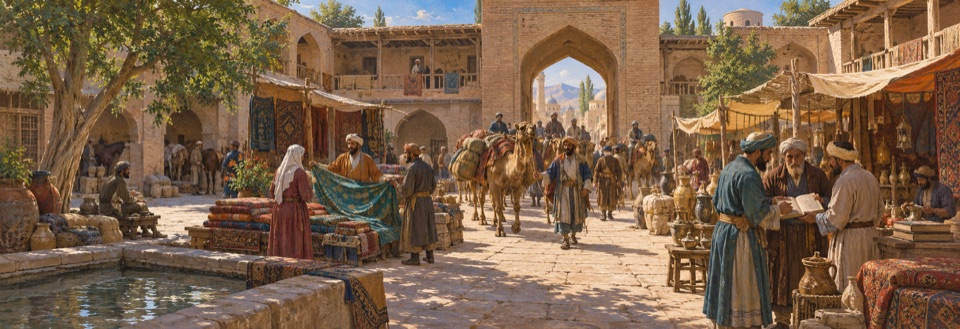
Caravans cross mountains and deserts, ports connect coastlines, and goods, knowledge and beliefs move between societies.
Selected events
Ordered by known year, month and day. Events without a known month or day follow other events in the same year; ongoing processes use their starting point.
Ajanta: Buddhist Art on Rock Walls
Caves, paintings and sculpture joined worship, residence and storytelling in a landscape built over several phases.
Teotihuacan: Planning, Monuments and Influence
Huge public monuments and ordered urban spaces supported a cultural influence that reached across Mesoamerica.
Writing, Calendars, and Rivalry in Maya Cities
Maya cities such as Tikal built temples and carved monuments, flourishing amid complex calendars, dynastic politics, and exchange among city-states.
Nalanda: Knowledge within a Monastic Institution
Residential and educational buildings supported centuries of organized learning and influenced other Asian Buddhist institutions.
The Hijra and the Formation of the Islamic Community
Muhammad and his followers migrated from Mecca to Medina, where a religious community gradually took shape; Islam subsequently spread through West Asia and farther afield.
Borobudur: A Buddhist Monument in Java
Square terraces, circular platforms and stupas gave Buddhist ideas a distinctive architectural form in Java.
Heian-kyo and Court Culture in Japan
Japan moved its capital to Heian-kyo, where court politics, Buddhism, and literature developed together, drawing on continental traditions while creating distinctive local cultural expression.
Charlemagne's Coronation and Imperial Ideals in Western Europe
Charlemagne, king of the Franks, was crowned emperor in Rome; cooperation between royal power and the Church left new political and cultural traditions in medieval Western Europe.
Angkor's Temples and Water-Based Urban Landscape
Khmer rulers built capitals, temples, and water-management systems in the Angkor region, linking agricultural production, royal power, and religious landscapes.
Translation and the Creation of Knowledge in Baghdad
Scholars in the Abbasid period translated knowledge from several languages into Arabic and continued research in medicine, mathematics, and astronomy.
Bagan: Temples across a River Plain
A royal centre beside the Ayeyarwady left a wide landscape of temples, stupas, paintings and sculpture.
Kilwa and the Swahili Coast
East African port cities brought gold and ivory from the African interior into Indian Ocean trade, developing a Swahili urban culture with local roots.
Cahokia: Mounds and Settlement Networks
An agricultural society in the Mississippi valley built major earthworks and linked a central settlement with surrounding villages.
Great Zimbabwe and Trade in the African Interior
Ancestors of the Shona built a large settlement with stone walls, supporting a political center through agriculture, livestock, and trade and bringing the southern African interior into Indian Ocean exchange.
Lalibela: Churches Hewn from Rock
Rock-hewn churches in the Ethiopian highlands became a lasting centre of Christian pilgrimage.
Nan Madol: A Stone-Built Center in the Pacific Islands
Communities along the coast of Pohnpei transported basalt to build artificial islands and ceremonial structures, revealing complex political and religious organization in Micronesia.
Chinggis Khan and Mongol Expansion
Temujin was acclaimed as Chinggis Khan; subsequent Mongol conquests reshaped Eurasian politics and altered the movement of people, technologies, and goods.
Polynesian Voyagers Reach Aotearoa
Eastern Polynesian voyagers reached Aotearoa, where Māori ancestors established communities in a new climate and ecological environment.
Rapa Nui: Moai and Ceremonial Landscapes
Island communities carved monumental statues and built ceremonial platforms, giving ancestral memory a visible place in the landscape.
Mansa Musa's Pilgrimage and Mali's Networks
The pilgrimage of Mali's ruler Mansa Musa made West Africa's wealth and political influence widely known, highlighting the vitality of trans-Saharan trade routes.
The Black Death: A Pandemic in Trading Networks
Plague spread rapidly along maritime and overland routes, causing population losses in many societies in Europe, West Asia, and North Africa and profound changes in labor and everyday life.
The Founding of Joseon and the Formation of a Confucian State
Yi Seong-gye replaced Goryeo and founded the Joseon dynasty; dynastic change, the later relocation of the capital, and institution-building together reshaped politics on the Korean Peninsula.