
c. 830 CE / West Asia & North Africa
Translation and the Creation of Knowledge in Baghdad
Scholars in the Abbasid period translated knowledge from several languages into Arabic and continued research in medicine, mathematics, and astronomy.
The story
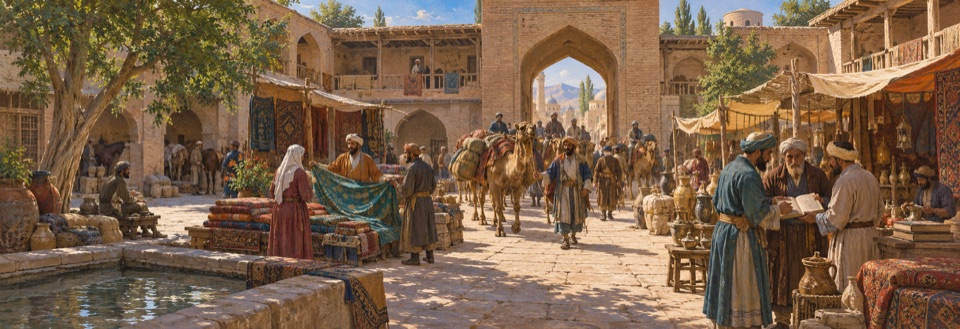
The timeline uses approximately 830 as a point of observation; translation activities did not begin that year. From the eighth to tenth centuries, translators, physicians, and patrons in Baghdad and neighboring areas promoted the translation of knowledge. Greek works often entered Arabic through Syriac, while Persian and Indian traditions also took part in the exchange. Scholars of different faiths did more than preserve ancient books: they revised, commented on, and innovated upon them. Familiar accounts of the House of Wisdom can reduce a broad scholarly network to a single institution, and its precise organizational form still requires cautious interpretation.
Elsewhere in the world
At the same time, Tang-era overland and maritime transport was also spreading books, religions, and goods; the movement of knowledge depended on multiple cities rather than a single route.
Dates and precision
c. 830 CE Observation point
A representative year used to observe long-term change, rather than its complete beginning or end.
Representative map location
Representative coordinates · 33.315°, 44.366°
Coordinates locate a representative point for the story. They do not mean the event happened only here and do not represent historical borders.
Bibliography
- University of Chicago Press, Isis | Mobilities of Science: The Era of Translation into Arabic
Sources are listed as bibliography titles, without external links. A reference does not mean every sentence or interpretation has been independently verified.