
c. 11th–14th centuries CE / Sub-Saharan Africa
Kilwa and the Swahili Coast
East African port cities brought gold and ivory from the African interior into Indian Ocean trade, developing a Swahili urban culture with local roots.
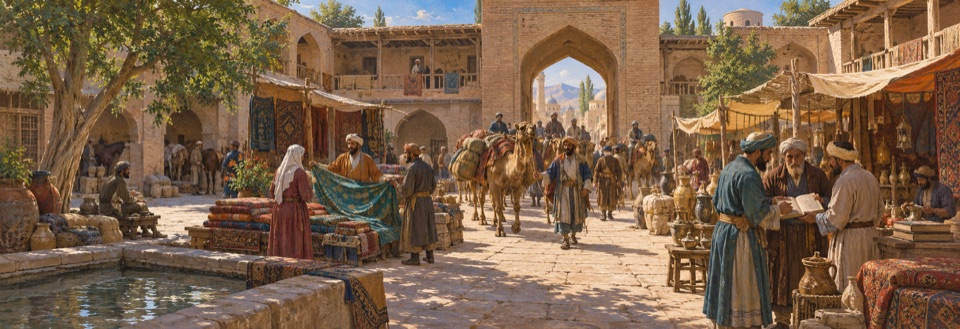
The story
The timeline uses approximately 1000 as a representative starting point for the eleventh century, rather than as the port city's exact founding year. Kilwa already had coinage and important mosques in the eleventh century and was especially prosperous in the thirteenth and fourteenth centuries. Local merchants connected goods from the interior with merchandise from the Arabian Peninsula, South Asia, and farther afield; ceramics at the site reflect extensive contacts. Swahili culture was grounded in local East African societies and changed through prolonged exchange, so these cities cannot simply be treated as colonial outposts founded by outsiders.
Elsewhere in the world
Chinese ceramics excavated at Kilwa connect East African port cities with Song- and Yuan-era production and Indian Ocean transshipment networks.
Dates and precision
c. 11th–14th centuries CE Approximate period
The dates describe a process over time; the interactive timeline uses its starting point.
Representative map location
Representative coordinates · -8.958°, 39.521°
Coordinates locate a representative point for the story. They do not mean the event happened only here and do not represent historical borders.
Bibliography
- UNESCO | Ruins of Kilwa Kisiwani and Songo Mnara
Sources are listed as bibliography titles, without external links. A reference does not mean every sentence or interpretation has been independently verified.