
Era / 1400–1749 CE
Global Encounters
A world connected by oceans
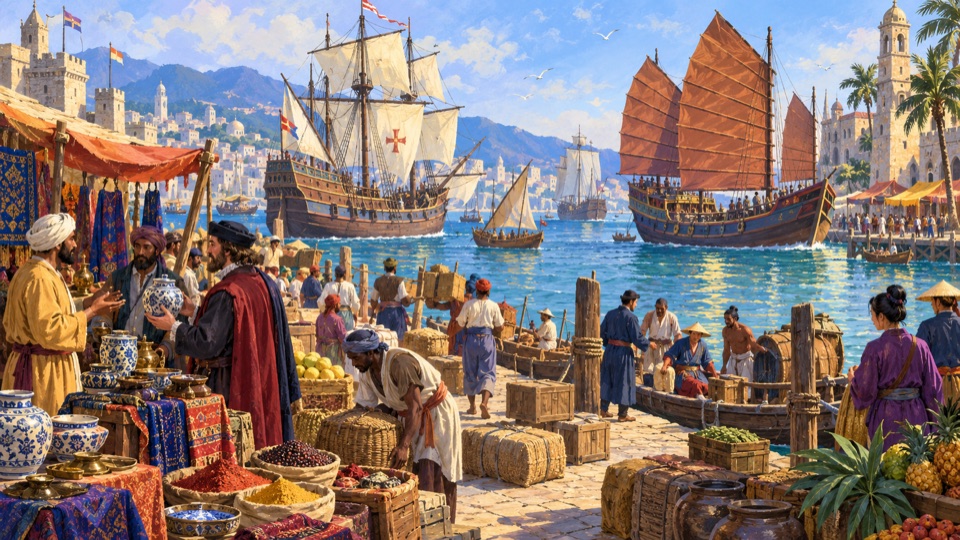
Sailing ships carry goods, knowledge and diseases across oceans, drawing distant societies into closer contact.
Selected events
Ordered by known year, month and day. Events without a known month or day follow other events in the same year; ongoing processes use their starting point.
Angkor's Temples and Water-Based Urban Landscape
Khmer rulers built capitals, temples, and water-management systems in the Angkor region, linking agricultural production, royal power, and religious landscapes.
Kilwa and the Swahili Coast
East African port cities brought gold and ivory from the African interior into Indian Ocean trade, developing a Swahili urban culture with local roots.
Great Zimbabwe and Trade in the African Interior
Ancestors of the Shona built a large settlement with stone walls, supporting a political center through agriculture, livestock, and trade and bringing the southern African interior into Indian Ocean exchange.
Nan Madol: A Stone-Built Center in the Pacific Islands
Communities along the coast of Pohnpei transported basalt to build artificial islands and ceremonial structures, revealing complex political and religious organization in Micronesia.
Rapa Nui: Moai and Ceremonial Landscapes
Island communities carved monumental statues and built ceremonial platforms, giving ancestral memory a visible place in the landscape.
Chan Chan: The Urban Order of Chimor
A royal capital on Peru’s northern coast organized power through distinct palace compounds before Inca conquest.
Timbuktu: Learning and Religion in West Africa
Mosques and centres of learning made the city a major setting for religious and intellectual exchange.
Zheng He's Fleets Sail into the Indian Ocean
The Ming dynasty sent Zheng He's fleets on long voyages, conducting diplomacy, exchange, and military activities along existing maritime networks and reaching as far as East Africa.
Hunminjeongum and the Korean Writing System
Sejong of the Joseon dynasty published Hunminjeongum, responding to difficulties in writing with a new script suited to the local language and broadening the possibilities for spreading knowledge.
Inca Roads Span the Andes
Inca rule centered on Cuzco expanded rapidly, with roads, storage facilities, and labor-service systems connecting mountains, coasts, and river valleys.
The Ottoman Capture of Constantinople
Ottoman armies captured Constantinople, ending the Byzantine government based there and rebuilding the city as the center of an empire spanning regions.
Gutenberg and the Spread of Printing in Europe
The combination of metal movable type, ink, and press technology gradually expanded the scale of book reproduction in Europe and changed the conditions for spreading knowledge.
1492: Sustained Contact Across the Atlantic
Columbus's fleet reached the Bahamas; the sustained contact that followed brought exchanges of species, colonial conquest, and immense changes to Indigenous societies.
Da Gama Reaches India and Maritime Colonial Expansion
A Portuguese fleet sailed around Africa to Calicut, entering an established Indian Ocean trading world; subsequent voyages gradually intertwined with armed outposts.
The Expansion of the Transatlantic Slave Trade
Colonial plantations and the slave trade forcibly displaced millions of Africans, building the Atlantic economy on profound deprivation of personal freedom.
Luther's Theses and the Reformation
Luther presented theses on indulgences, and printing carried the dispute across cities; subsequent reforms changed relations among churches, states, and education in Europe.
The Fall of Tenochtitlan and Colonial Conquest
Spanish forces and numerous Indigenous allies captured the Aztec capital, as epidemics, siege, and local politics together reshaped Mesoamerica.
The Mughal Dynasty and the Reshaping of South Asia
Babur's victory began the Mughal dynasty, whose succeeding rulers shaped large areas of South Asia through conquest, alliances, and administrative integration.
The Manila Galleons and Silver Across the Pacific
The route between the Philippines and Mexico connected Asian goods such as silk and porcelain with American silver, fostering sustained exchange across the Pacific.
The Founding of the Tokugawa Shogunate and Edo as a Political Center
Tokugawa Ieyasu founded the shogunate, making Edo a center of warrior government; the shogunate, daimyo, and imperial court still in Kyoto together formed the power structure of early modern Japan.
The Taj Mahal: Courtly Patronage and Remembrance
A marble mausoleum at Agra joined royal remembrance with the artistic traditions of the Mughal court.
Newton’s Principia: Motion in Mathematical Form
Laws of motion and universal gravitation brought terrestrial movement and celestial orbits into a shared mathematical framework.