
1565–1815 CE / South & Southeast Asia
The Manila Galleons and Silver Across the Pacific
The route between the Philippines and Mexico connected Asian goods such as silk and porcelain with American silver, fostering sustained exchange across the Pacific.
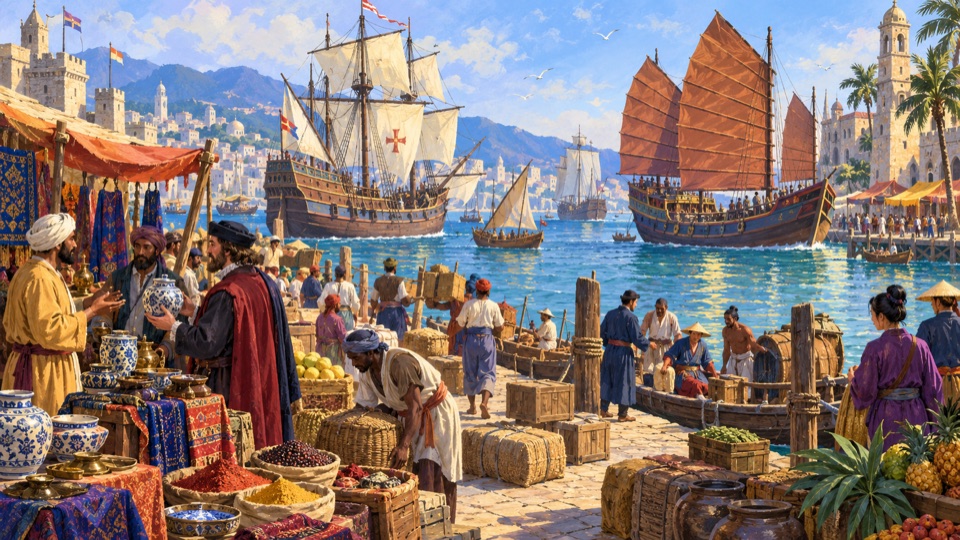
The story
From 1565, Spanish colonial networks gradually established a Pacific route between the Philippines and Mexico; Manila later became an important distribution port. Galleons carried Asian silk, porcelain, ivory, and spices to Acapulco, from where they reached other markets through overland routes and Atlantic shipping, while American silver flowed into Asia. Merchants, artisans, and maritime workers from China, the Philippines, and many other places took part in its operation, and objects and artistic forms traveled with the goods. The route depended on colonial administration, mine labor, and port societies, rather than purely equal exchange; its continuation connected the Pacific with a wider global economy.
Elsewhere in the world
American silver entered Asia along several Pacific and Indian Ocean routes, tying local production, consumption, and monetary demand more closely to markets across continents.
Dates and precision
1565–1815 CE Ongoing process
The dates describe a process over time; the interactive timeline uses its starting point.
Representative map location
Representative coordinates · 14.6°, 120.984°
Coordinates locate a representative point for the story. They do not mean the event happened only here and do not represent historical borders.
Bibliography
- The Metropolitan Museum of Art | The Manila Galleon Trade (1565–1815)
Sources are listed as bibliography titles, without external links. A reference does not mean every sentence or interpretation has been independently verified.