
1492 CE / Americas
1492: Sustained Contact Across the Atlantic
Columbus's fleet reached the Bahamas; the sustained contact that followed brought exchanges of species, colonial conquest, and immense changes to Indigenous societies.
The story
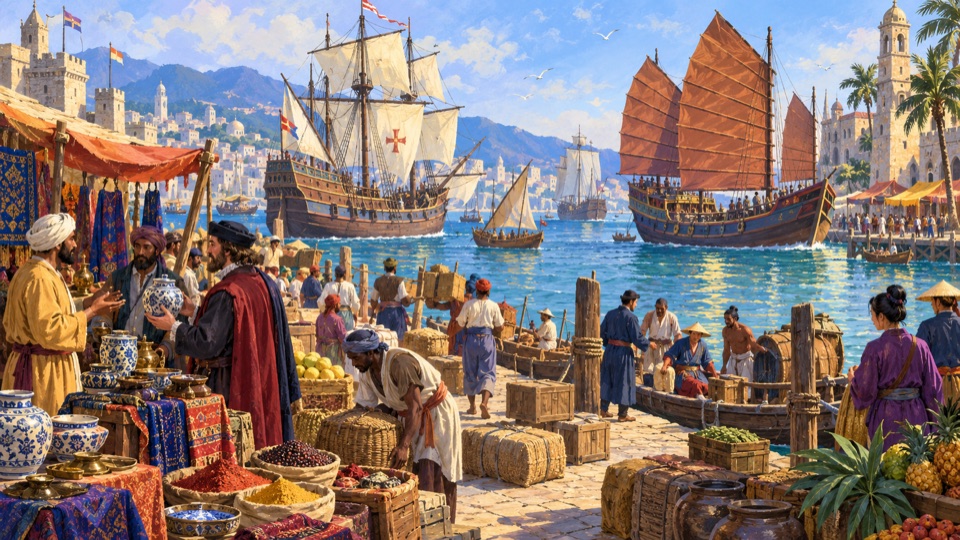
Sailing for the Spanish crown, Columbus reached the Bahamas and encountered local Indigenous people. This was not humanity discovering an empty continent, but two worlds with long-established complex societies entering sustained contact. Crops, animals, people, and pathogens subsequently crossed the Atlantic; colonial conquest, forced labor, and epidemics brought disaster to many Indigenous communities. The map uses an illustrative point in the island group without asserting an answer to the disputed question of the first landing island.
Elsewhere in the world
As Atlantic contact expanded, the Inca were expanding in the Andes, while the Indian Ocean already had maritime networks spanning Africa and Asia.
Dates and precision
1492 CE Documented date
Positioned by the documented year, month or day; missing months and days are not inferred.
Representative map location
Representative coordinates · 24.1°, -74.5°
Coordinates locate a representative point for the story. They do not mean the event happened only here and do not represent historical borders.
Bibliography
- Library of Congress | 1492: An Ongoing Voyage
Sources are listed as bibliography titles, without external links. A reference does not mean every sentence or interpretation has been independently verified.