
Era / 1750–1913 CE
Age of Revolutions
Machines, rights and revolution
Steam power changes production and travel, print spreads new ideas, and people debate rights and the future of society.
Selected events
Ordered by known year, month and day. Events without a known month or day follow other events in the same year; ongoing processes use their starting point.
The Expansion of the Transatlantic Slave Trade
Colonial plantations and the slave trade forcibly displaced millions of Africans, building the Atlantic economy on profound deprivation of personal freedom.
The Manila Galleons and Silver Across the Pacific
The route between the Philippines and Mexico connected Asian goods such as silk and porcelain with American silver, fostering sustained exchange across the Pacific.
Machines, Coal, and Industrialization
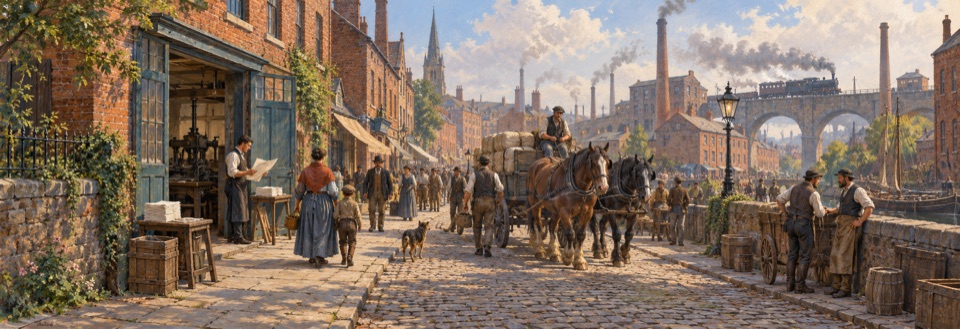
Factories, steam power, and coal use gradually expanded in Britain, increasing the scale of production while bringing new problems for labor and the environment.
The Thirteen North American Colonies Declare Independence
The Continental Congress adopted the Declaration of Independence, arguing for independence through natural rights and the consent of the governed; the war continued afterward.
The French Revolution and the Declaration of Rights
The revolution challenged the old regime; the Declaration of the Rights of Man and of the Citizen advanced ideas of liberty, legal equality, and sovereignty while leaving disputes over the boundaries of rights.
Haitian Independence: Enslaved People Transform the Atlantic
After war and repeated struggles, the Haitian Revolution won independence, destroyed colonial slavery, and challenged an order based on race and enslavement.
Wars of Independence and New States in Spanish South America
A crisis of the Spanish crown prompted struggles for self-government and independence in the Americas; forces led by Bolívar, San Martín, and others fought across regions and established new states.
Brazilian Independence: Another Path in Portuguese America
Pedro declared separation from Portugal at Ipiranga; Brazil established an independent state as an empire, following a different path from Spanish South America.
Abolition in British Colonies and Incomplete Freedom
Prolonged resistance and abolitionist movements pushed Britain to pass an abolition act; enslaved status gradually ended in the colonies, but compulsory apprenticeship delayed the realization of freedom.
The Treaty of Waitangi and Disputes over Māori Sovereignty
British representatives and Māori chiefs signed a treaty whose Māori and English texts expressed authority differently, becoming an important basis for debates over colonial government and rights.
The Indian Rebellion of 1857 and the Transformation of Colonial Rule
Indian soldiers and inhabitants in several regions resisted East India Company rule; although the rebellion was suppressed, it prompted the British crown to take direct control of colonial administration.
On the Origin of Species and Natural Selection
Darwin used extensive observations to explain changing species, making the diversity of life a question of historical processes.
The U.S. Civil War and the Constitutional Abolition of Slavery
A crisis over slavery and the survival of the Union developed into civil war, changing the structure of the country and advancing the abolition of slavery at the constitutional level.
The Meiji Restoration and Japan's Transformation
After the shogunate collapsed, the new government pursued centralization and reforms in education and industry, rapidly changing Japanese society and its foreign relations.
Women in New Zealand Win the Parliamentary Vote
Sustained petitioning helped secure an electoral law in New Zealand, making it the first self-governing country to grant women the right to vote in parliamentary elections.
Australian Federation: Six Colonies Form a Nation
Six British colonies formed the Commonwealth of Australia, becoming states with governing powers divided between the federal and state governments.
The Mexican Revolution and the Constitution of 1917
A revolution against long-standing rule became intertwined with struggles over land, labor, and state power, with the Constitution of 1917 marking an important stage in institutional reconstruction.
The Republic of China Is Founded and Imperial Rule Ends
Sun Yat-sen took office as provisional president in Nanjing, and the Qing emperor subsequently abdicated; the establishment of a republic began a new phase of state-building while leaving problems of divided power and war.