
Era / 3500–801 BCE
Early Civilizations
Cities and the birth of civilizations
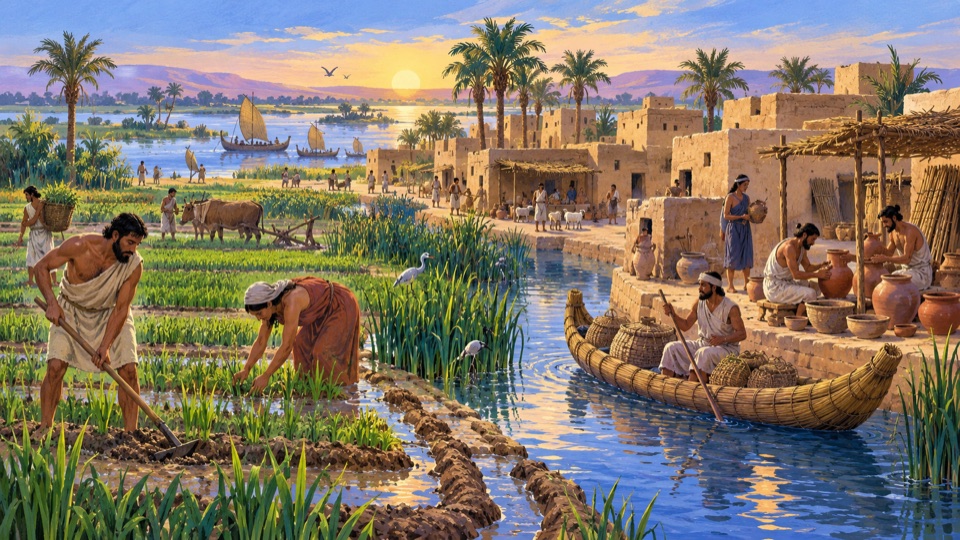
Rivers water fields, towns bring artisans and traders together, and writing begins to record everyday life.
Selected events
Ordered by known year, month and day. Events without a known month or day follow other events in the same year; ongoing processes use their starting point.
Uruk: Writing Emerges from the Accounting Room
The expansion of cities in southern Mesopotamia gave rise to early writing for recording goods and labor, changing how society was organized.
Caral: Early Cities in the Andes
Monumental platforms and sunken courts grew within a coastal economy linking farming, fishing and exchange.
Indus Cities and Public Infrastructure
Cities such as Mohenjo-daro developed brick-built neighborhoods, drainage systems, and standardized objects, revealing another path to early urbanization.
The Giza Pyramids and the Nile State
Agriculture and transport along the Nile supported large tomb-building projects, and the pyramids inscribed royal power, religion, and social mobilization in stone.
The Code of Hammurabi and Babylonian Kingship
A Babylonian ruler had disputes over families, property, and work inscribed on a stone stele, asserting royal power through judicial authority and leaving a record of ancient social hierarchies.
The Hittite Capital Hattusha and Bronze Age Diplomacy
Centered on Hattusha, the Hittite kingdom of Anatolia participated in the international networks of Bronze Age West Asia through war, treaties, and written archives.
Lapita Voyagers Expand into the Pacific
Communities carrying pottery, crops, and maritime knowledge migrated into Remote Oceania, laying foundations for the later emergence of Polynesian societies.
Dynastic Life on the Oracle Bones of Yin Xu
The Shang royal court inscribed divination questions on turtle shells and animal bones, leaving valuable records of activities such as warfare, harvests, and ritual sacrifice.
Olmec Colossal Stones and Ceremonial Centers
Large earthen platforms, stone sculptures, and networks of exchange appeared along the Gulf coast of Mexico, and Olmec art influenced many parts of Mesoamerica.